KCCU Investment Services Home
Home NavigationMENU
  • Contact
  • LPL
  • Guided Wealth Portfolios
  • Account View
Lifestyle

The Three Keys to a Great Password

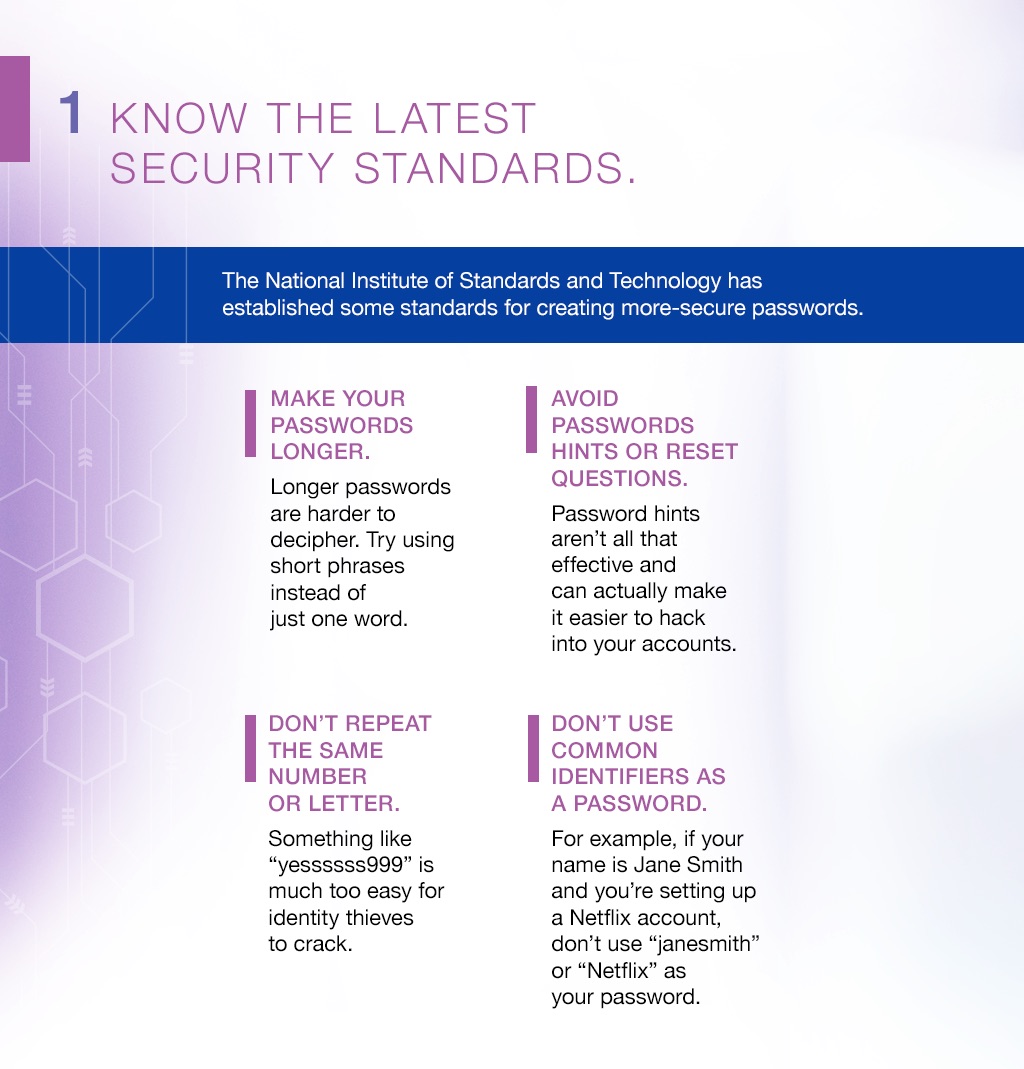
A great password is often the only thing standing between you and identity theft. But what makes a password really secure? Turns out, there are some important guidelines to follow to keep information safe. Read on for three smart tips.1. Know the latest  security standards.The National Institute of Standards and Technology has established some new rules for setting more-secure passwords.MAKE YOUR PASSWORDS LONGER.Longer passwords are harder to decipher. Try using short phrases instead of just one word.AVOID PASSWORDS HINTS OR RESET QUESTIONS. Password hints aren’t all that effective and can actually make it easier to hack into your accounts.DON’T REPEAT THE SAME NUMBER OR LETTER.Something like “yessssss999” is much too easy for identity thieves to crack.DON’T USE COMMON IDENTIFIERS AS A PASSWORD.For example, if your name is Jane Smith and you’re setting up a Netflix account, don’t use “janesmith” or “Netflix” as your password.2.Don't use the same  password more than once. By using the same password on multiple services, you are potentially giving hackers access to every service where you're using that password. This is like having a single key that opens your house, your, car, and your bank's safety deposit box. If someone steals that key, they can access everything you own. Always create different keys, or passwords, for separate accounts.3. Make use of a  password manager. A password management tool is your greatest ally. These are  programs or apps that will create unique passwords on each of your accounts and store them all for you in a single, secure location, so you'll never lose them again. They can also sync with multiple devices and  auto-populate passwords whenever you need them, saving you a ton of time and trouble. The World Wide Web can be complicated,  but setting secure passwords doesn't have to be. With a bit of effort, you can use smart practices to help keep all your accounts safe and secure. SOURCE: The National Institute of Standards and Technology, 2019
 

Related Content

When to Self-Insure

Choosing to bear the financial burden of an adverse event is called self-insuring. Do you know what that entails?

What to Look for in Personal Finance Apps

An increasing number have been developed to help individuals with their personal finances.

Grantor Retained Annuity Trusts (GRATs)

Explaining Grantor Retained Annuity Trusts (GRATs) and their benefit to estate strategy.

LPL Financial Form CRS

Check the background of your financial professional on FINRA's BrokerCheck.

The content is developed from sources believed to be providing accurate information. The information in this material is not intended as tax or legal advice. Please consult legal or tax professionals for specific information regarding your individual situation. Some of this material was developed and produced by FMG Suite to provide information on a topic that may be of interest. FMG Suite is not affiliated with the named representative, broker - dealer, state - or SEC - registered investment advisory firm. The opinions expressed and material provided are for general information, and should not be considered a solicitation for the purchase or sale of any security.

We take protecting your data and privacy very seriously. As of January 1, 2020 the California Consumer Privacy Act (CCPA) suggests the following link as an extra measure to safeguard your data: Do not sell my personal information.

Copyright 2026 FMG Suite.

Securities and advisory services offered through LPL Financial (LPL), a registered investment advisor and broker-dealer (member FINRA/SIPC). Insurance products are offered through LPL or its licensed affiliates. Kellogg Community Credit Union and KCCU Investment Services are not registered as a broker-dealers or investment advisor. Registered representatives of LPL offer products and services using KCCU Investment Services, and may also be employees of Kellogg Community Credit Union. These products and services are being offered through LPL or its affiliates, which are separate entities from, and not affiliates of, Kellogg Community Credit Union or KCCU Investment Services. Securities and insurance offered through LPL or its affiliates are:

  • Not Insured by NCUA or Any Other Government Agency
  • Not Credit Union Guaranteed
  • Not Credit Union Deposits or Obligations
  • May Lose Value

The LPL Financial registered representatives associated with this website may discuss and/or transact business only with residents of states in which they are properly registered or licensed. No offers may be made or accepted from any resident of any other state.  

Your Credit Union (“Financial Institution") provides referrals to financial professionals of LPL Financial LLC (“LPL") pursuant to an agreement that allows LPL to pay the Financial Institution for these referrals. This creates an incentive for the Financial Institution to make these referrals, resulting in a conflict of interest. The Financial Institution is not a current client of LPL for advisory services.  Please visit https://www.lpl.com/disclosures/is-lpl-relationship-disclosure.html
Contact

KCCU Investment Services
Office: 269-441-1554
Office: 269-441-1553
Fax: 269-441-1524

6427 B Drive N
Battle Creek, MI 49014

jerald.pawlowicz@lpl.com

Quick Links

  • Retirement
  • Investment
  • Estate
  • Insurance
  • Tax
  • Money
  • Lifestyle
  • Latest Articles
  • All Videos
  • All Calculators